
Many have wondered what eternity with God will look like. Revelation 21-22 gives a vivid picture of this future, describing a new heaven, a new earth, and the Holy City called the New Jerusalem.
It shows a real place where God will live among His people forever, free from pain, death, and sorrow.

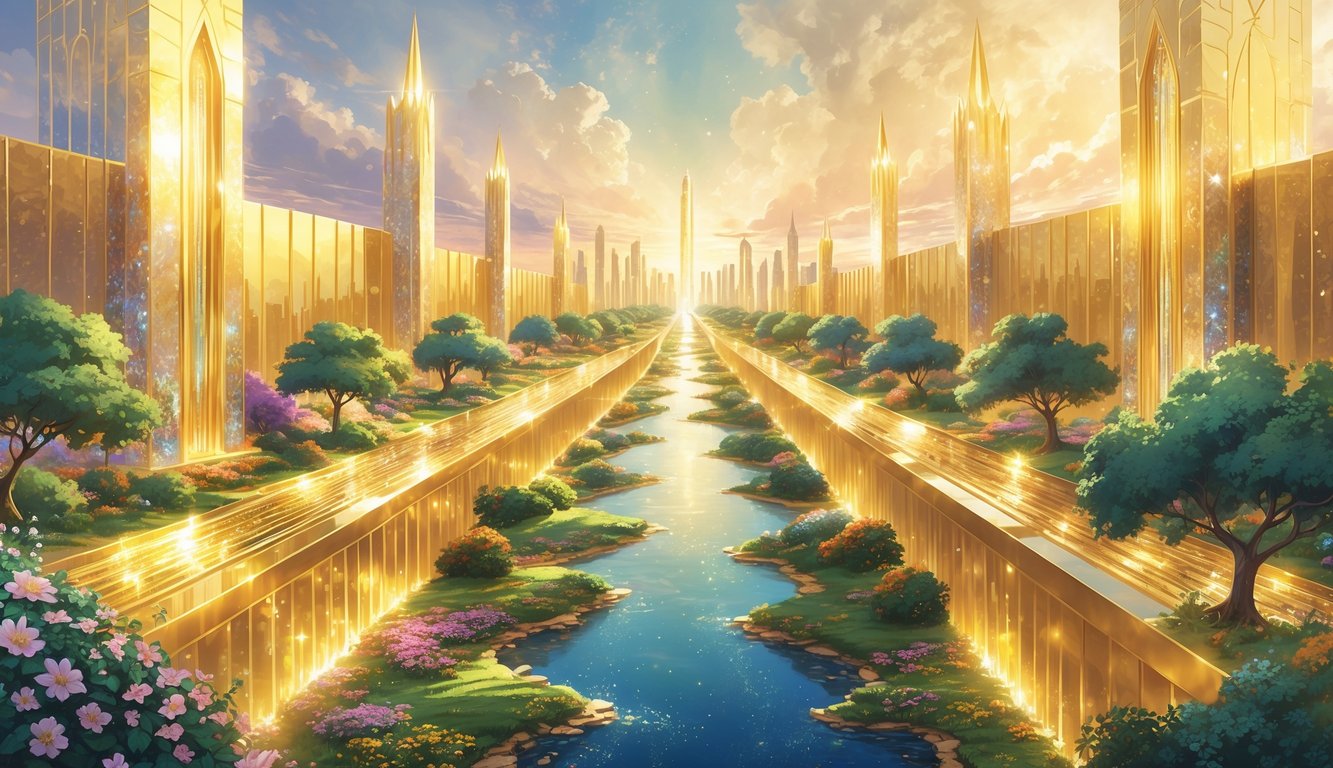
This vision is not just symbolic—it offers concrete details about the city’s beauty, its perfect security, and the life within its walls. From streets of gold to the river of life, every part reflects God’s presence and His promise to make all things new, as seen in the description of the New Jerusalem.

By exploring these chapters, anyone can see how God’s plan for eternity brings hope and purpose today. The prophecy invites all to consider not only the future glory of the eternal city but also the decision to be part of it.
The Vision of the New Jerusalem in Revelation 21-22
The New Jerusalem appears in the final chapters of the Book of Revelation as a real city where God dwells with His people. It comes after the final judgment, marking the start of a new creation where sin, death, and sorrow are gone forever.
Hope of Eternity: The Promise Fulfilled
In Revelation 21, John sees “a new heaven and a new earth” after the old ones pass away. The New Jerusalem comes down from God, prepared like a bride, showing the permanent union between God and His people.
God’s dwelling is now “with them,” and He will wipe away every tear. There will be no more death, mourning, or pain.
The city’s description in Revelation 21:10-21 includes walls of jasper, streets of pure gold, and gates made of single pearls. These details show its beauty and holiness.


The city has no temple because “the Lord God Almighty and the Lamb are its temple” (Revelation 21-22).
The Role of Prophecy in Revelation
The vision of the New Jerusalem is a prophetic promise. In the Book of Revelation, prophecy encourages the faithful and confirms God’s plan for history.
Prophecy connects past promises with future fulfillment. The city reflects God’s covenant with His people, echoing Old Testament prophecies about a restored Zion.
This vision assures readers that evil will not have the final word. The defeat of Satan and the arrival of the New Jerusalem show that God’s justice and mercy are complete.
For those studying the Bible, this passage reminds them that prophecy is both a warning and a comfort. It calls people to remain faithful while offering a clear picture of God’s final victory.




John’s Revelation and the Church
John, exiled on Patmos, received this vision from God through an angel. He recorded it for the church so believers could understand God’s plan.
The New Jerusalem is not only a future home but also a picture of the church perfected. In Revelation 22, the river of the water of life flows from God’s throne, and the tree of life brings healing to the nations.
The imagery shows the church’s eternal relationship with Christ. The Lamb is central, and His people see His face and serve Him forever.
For the early church, this message brought strength during persecution. For today’s readers, it still offers hope and a reminder of the unchanging promises of God (What is the New Jerusalem?).
The New Heaven and New Earth
The vision in Revelation 21 describes a complete renewal of creation. John sees a reality where God lives with His people, free from death, pain, and sorrow.
This change affects not only humanity but also the entire created order.
Creation of a Renewed World
John writes, “Then I saw a new heaven and a new earth” (Revelation 21:1). The word “new” points to transformation, not simple replacement.
The renewed creation will be free from decay and corruption. This idea matches the promise in Isaiah 65:17, where God declares He will create new heavens and a new earth.

The former troubles will not be remembered. In the new creation, God’s presence will not be distant.
He will dwell with His people in an unbroken relationship. Nature, society, and spiritual life will be restored to harmony.
The sea being “no more” in John’s vision may symbolize the removal of chaos and danger. It marks the end of anything that separates God from His people.
Fulfillment of Old Testament Prophecies
The promise of a new heaven and new earth is not unique to Revelation. Prophets like Isaiah spoke of it centuries earlier.
In Isaiah 65 and 66, this renewal includes peace, long life, and joy for God’s people. Peter also writes in 2 Peter 3 about a future where the heavens will pass away with a roar, and the earth will be laid bare before being renewed.
This shows a consistent biblical theme of God’s plan to restore creation. These prophecies assure believers that God’s promises are certain.
The new creation is not an abstract hope but a specific future reality. It will fulfill God’s covenant purposes for His people and the world.
The link between Old Testament prophecy and Revelation’s vision shows the unity of God’s plan from beginning to end.
The Passing of the Old Order
John says “the first heaven and the first earth had passed away” (Revelation 21:1). This “old order of things” includes death, mourning, crying, and pain.
These will no longer exist. The passing away is not random destruction.
It is the removal of all that is broken by sin. The new heavens and new earth will be free from curse and corruption.
In this renewed world, God’s dwelling place will be with humanity in the New Jerusalem. There will be no temple because God Himself will be the center of worship.
This change marks the final stage of redemption. The separation between heaven and earth will end, and God’s people will live in His presence forever.
The Holy City: Description and Symbolism
The holy city in Revelation 21–22 is described with clear details about its size, structure, and beauty. Its design reflects God’s order and presence, and its materials show great value and meaning to believers.
Structure and Design of the City
The New Jerusalem is called the city of God and comes down from heaven. It has a perfect, square shape, with each side measuring 12,000 stadia (about 1,400 miles).
Its height matches its length and width, giving it a cube-like form similar to the Holy of Holies in the temple. The walls are made of jasper, clear as crystal, and measure 144 cubits thick.
The streets are made of pure gold, transparent like glass. This design shows purity, stability, and the glory of God’s dwelling place.
The city has no temple building because God and the Lamb are its temple. The light of God’s glory provides constant illumination, so there is no need for the sun or moon.
Nations will walk by this light, and kings will bring their honor into it, reflecting its role as the eternal holy Jerusalem described in Revelation 21.
Precious Stones and Foundations
The city’s wall rests on twelve foundations, each decorated with a different precious stone. These stones include:
| Foundation | Stone Name | Color/Appearance |
|---|---|---|
| 1 | Jasper | Clear, crystal-like |
| 2 | Sapphire | Deep blue |
| 3 | Chalcedony | Blue-gray |
| 4 | Emerald | Bright green |
| 5 | Sardonyx | White with red layers |
| 6 | Sardius | Deep red |
| 7 | Chrysolite | Golden yellow |
| 8 | Beryl | Sea green |
| 9 | Topaz | Yellow-gold |
| 10 | Chrysoprasus | Apple green |
| 11 | Jacinth | Reddish-orange |
| 12 | Amethyst | Purple |
Each foundation bears the name of one of the twelve apostles of the Lamb. The variety of stones reflects beauty, permanence, and the richness of God’s covenant promises.
The Gates and the Twelve Tribes of Israel
The city has twelve gates, each made from a single pearl. Three gates face each cardinal direction—north, south, east, and west—matching the layout seen in Ezekiel 48.
Each gate bears the name of one of the twelve tribes of Israel. This shows the unity of God’s people from both the Old and New Covenants.
The gates are never shut, symbolizing constant access for those whose names are written in the Lamb’s book of life. Angels stand at each gate, serving as both guardians and witnesses to the holiness of the city of God.
The open gates also show that the city is a place of safety, peace, and welcome for all who belong to God.
God’s Presence and the Lamb in the New Jerusalem
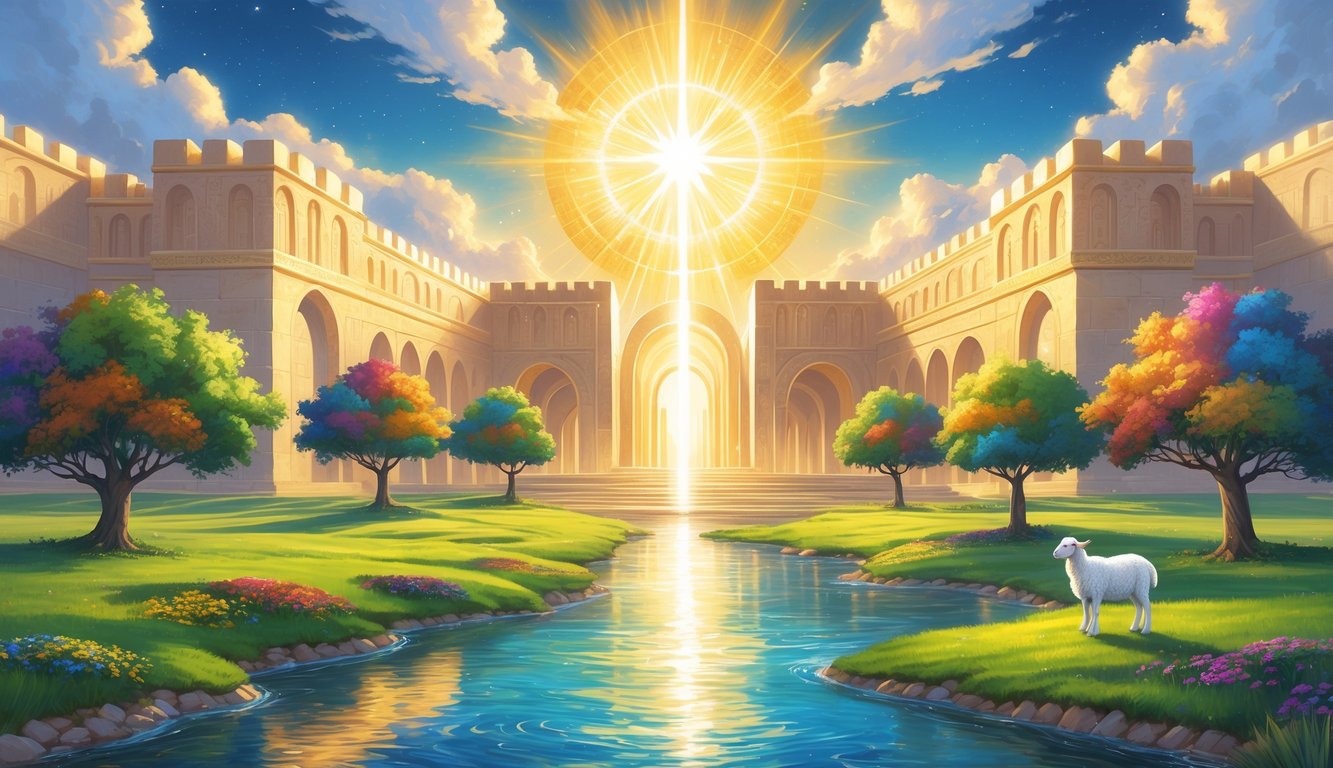
In the New Jerusalem, God’s presence is constant and direct. The city shines with the glory of God, and the Lamb, Jesus Christ, is at its center.
There is no temple because the Lord God Almighty and the Lamb are themselves its temple. Worship and fellowship are unbroken.
God Dwelling with Humanity
In this eternal city, God lives among His people in a personal and direct way. As Revelation 21:22 describes, there is no need for a physical temple because the Lord God Almighty and the Lamb are its temple.
This direct dwelling fulfills the promise that God will be with them and they will be His people. There is no separation between the divine and humanity.
The relationship is face-to-face, without barriers. The Alpha and Omega, who began creation, now completes it by restoring perfect fellowship.
The Glory of God and the Light of the Lamb
The city does not need the sun or moon for light because the glory of God illuminates it, and the Lamb is its lamp. Every part of the city is filled with pure, constant light.
According to BibleRef’s explanation of Revelation 21:22, this light represents both God’s presence and His truth. There is no darkness, no shadow, and no night.
The nations walk by this light, and the kings of the earth bring their glory into it. The Lamb, Jesus Christ, is central to this illumination, showing that His role in salvation continues into eternity as the source of life and clarity for all.
The Bride of Christ

The New Jerusalem is also described as the Bride of Christ, a symbol of God’s redeemed people. In Revelation 21:9-14, the city is shown as a bride beautifully prepared for her husband.
This image represents purity, faithfulness, and love. It highlights the covenant relationship between Jesus Christ and His people.
Their union is based on His sacrifice as the Lamb who takes away sin. The bride’s beauty comes from the glory of God shining through her.
This reflects the transformation of believers into a holy community, fully united with Christ in the presence of the Lord God Almighty.
Life, Healing, and Worship in the Eternal City
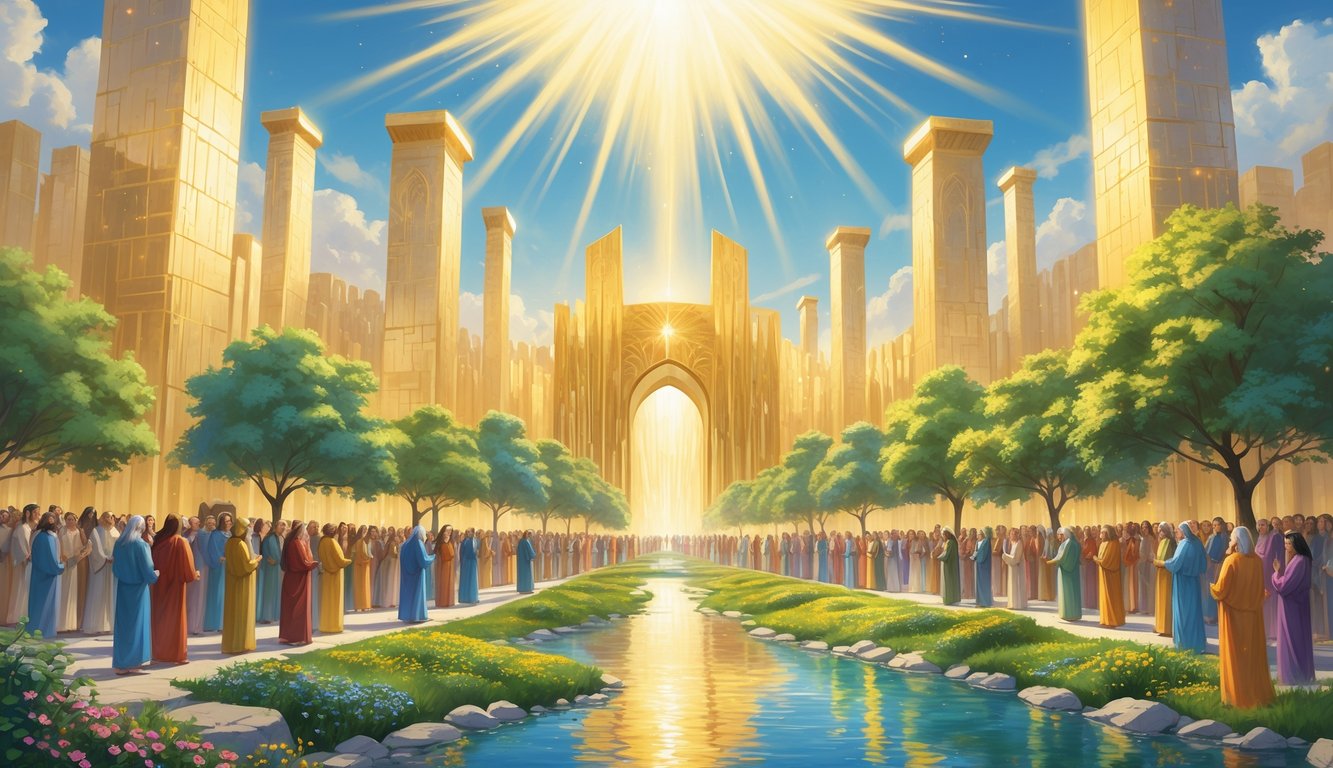
In the vision of the New Jerusalem, life flows from God’s presence. He brings renewal and peace to all who dwell there.
Every part of the city reflects God’s care, from the pure water that sustains life to the unbroken fellowship between Him and His people.
River of Life and Water of Life
At the center of the city flows the river of life. It is clear as crystal and comes directly from the throne of God and the Lamb.
This river symbolizes the water of life, which Jesus promised to those who believe in Him. The imagery recalls His offer of living water in John 4:14, pointing to eternal satisfaction and spiritual renewal.
In the New Jerusalem, this water is not just a symbol—it is part of the city’s design, showing God’s direct provision. The river’s placement through the middle of the main street suggests that life in the city centers on God’s sustaining presence.
No one will thirst or lack what is needed to live in perfect health and joy.
Tree of Life and Healing of the Nations
On each side of the river stands the tree of life. This tree first appeared in Genesis, but in the New Jerusalem it is fully accessible.
It bears twelve kinds of fruit, producing a new crop each month. The leaves bring the healing of the nations.
This does not mean sickness remains, because Revelation 21:4 says there will be no more death or pain. Instead, it points to lasting peace, unity, and restoration among all peoples.
The tree’s constant fruitfulness shows that God’s provision never ends. Its presence on both sides of the river means everyone in the city has complete access to it.
Worship and Eternal Fellowship
Life in the city is marked by worship and close fellowship with God. There is no temple building, because the Lord God Almighty and the Lamb are its temple as described in Revelation 21:22.
Prayer will not be hindered by distance or time. God’s people will see His face and serve Him directly.
Worship will be a natural part of life, not limited to set times or rituals. Every moment will be shared with Him in perfect joy and unity.
Judgment, Victory, and the Invitation to Eternity
God’s plan for the end of the age includes both justice and restoration. Those who reject Him face final judgment, while those who belong to Christ receive eternal peace and life in His presence.
These events mark the completion of God’s promises and the start of His everlasting kingdom.
The Second Death and Lake of Fire
Revelation describes the second death as the final separation from God. This occurs after the Day of the Lord, the Millennium, and the last judgment.
The lake of fire is the place where death, Hades, and all whose names are not in the Book of Life go. It is the end result of rejecting Christ’s offer of salvation through His blood.
This judgment follows the defeat of evil, including the events tied to the seven last plagues and the 2nd coming of Christ. Unlike the first death, which is physical, the second death is eternal and irreversible.
The apostles taught that this is the ultimate consequence for sin. Paul wrote in 2 Corinthians 5 that all must appear before Christ’s judgment seat, and this includes both believers and unbelievers.
The Overcomers and Eternal Life
Those who trust in Christ and remain faithful are called overcomers. They are promised eternal life in the New Jerusalem, free from pain, death, and sin.
Believers become new creations, as Paul explained in 2 Corinthians 5:17—the old life is gone, and the new has come. This transformation is possible only through the blood of Christ.
In the eternal city, they will live in peace and enjoy fellowship with God and the Lamb. The twelve apostles are honored there, with their names inscribed on the city’s foundations, as described in Rev. 22.
Overcomers will see the fulfillment of God’s promises, dwelling with Him forever in a place where nothing impure can enter.
Final Invitation and Promise
At the close of Revelation 22, Christ offers an open invitation: “Let the one who is thirsty come.”
This call is for all who desire the water of life, given without cost.
The invitation is urgent because the time is short.
The events of the rapture, the Millennium, and the final judgment will not be delayed forever.
The apostles, including John who recorded the vision, affirmed that Christ is coming soon.
His return will bring judgment for the wicked and eternal reward for the faithful.
