
John’s vision in Revelation 4-5 opens with an invitation into heaven. He sees the throne of God surrounded by constant worship.
The scene shifts the focus from earthly struggles to the center of all authority and power. God reigns over all creation, and Jesus, the Lamb, holds the only authority to open the scroll of God’s plan.

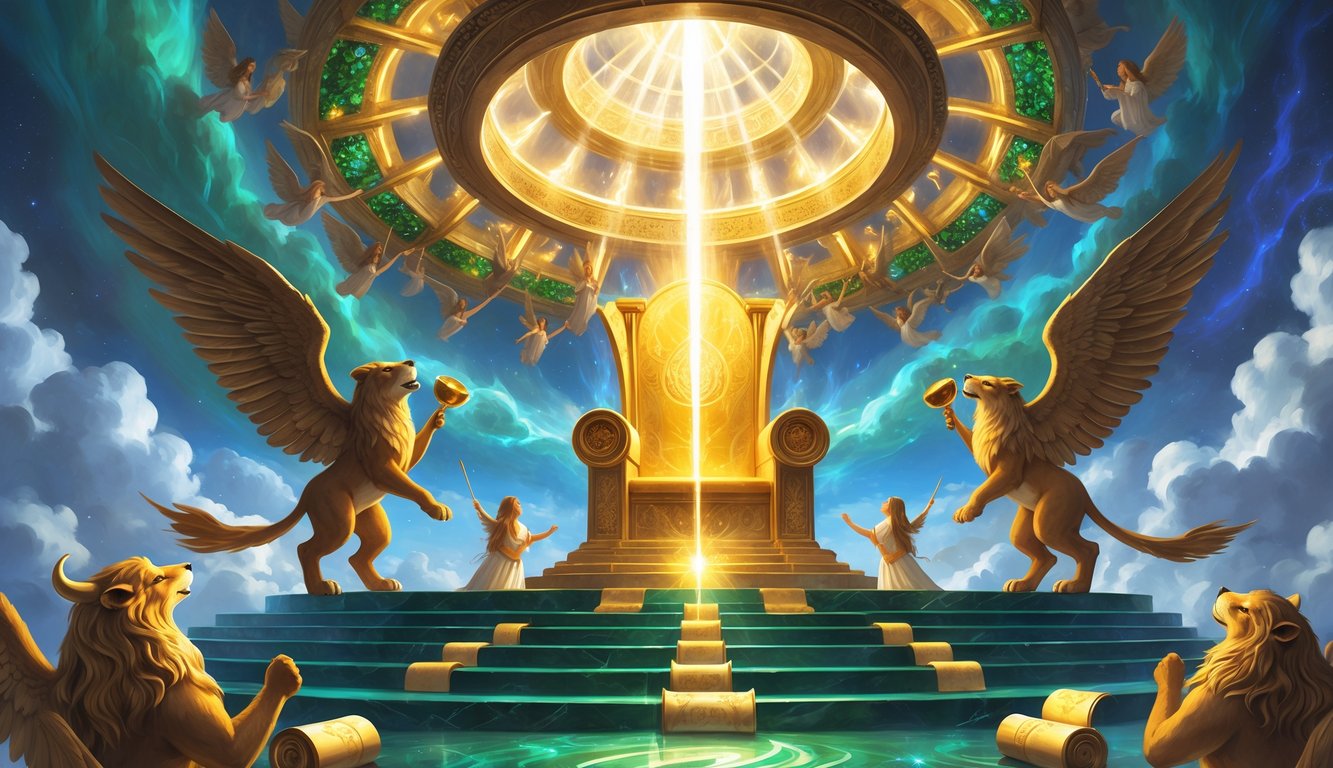
In this vision, the throne is not just a seat. It is the symbol of God’s sovereignty.

Heavenly beings declare His holiness without pause, as described in the worship in God’s throne room passage. When the Lamb takes the scroll, it reveals His role in redemption and the future of God’s kingdom.
This scene blends worship, symbolism, and prophecy. It connects Old Testament imagery with the hope of God’s final plan.
The vision invites reflection on what it means to live under the reign of the One who sits on the throne.
John’s Vision of the Throne Room
John described a vivid scene in Revelation 4 where he was shown the throne of God in heaven. His account moves from earthly concerns to a setting filled with light, sound, and continuous worship.
This reveals God’s power and authority over all creation.


The Open Door to Heaven
John saw an open door in heaven and heard a voice like a trumpet calling him to enter. This marked a clear invitation to witness events that “must take place after this” as described in Revelation 4:1.
The open door symbolized direct access to God’s presence. It contrasted with the closed door from the message to the church in Laodicea, showing that God’s invitation was now extended to John.
From this vantage point, John would see the throne room in detail. He described what was before, around, and above the throne, focusing on God’s majesty.
This moment set the stage for the heavenly worship that followed.
John’s Spiritual Experience

John stated that he was “in the Spirit” when the vision began. This phrase indicated a spiritual state where God enabled him to perceive heavenly realities.


In this state, John could observe the throne room without being physically present in heaven. He recorded what he saw with precision—colors like jasper and carnelian, a rainbow resembling an emerald, and elders seated on thrones.
The scene also included lightning, rumblings, and peals of thunder coming from the throne, signaling God’s power and authority. Seven lamps, representing the seven Spirits of God, burned before the throne, as noted in this description of Revelation 4:5.
Transition From Earth to Heaven
Before Revelation 4, John had been recording messages to the seven churches. Those messages addressed real congregations on earth, with specific encouragements and warnings.
The vision shifted his focus from earthly challenges to the heavenly throne. This transition emphasized that God’s rule in heaven shapes events on earth.
By moving from the earthly churches to the heavenly throne room, John’s vision connected God’s sovereignty with the unfolding events of Revelation. The scene prepared the way for the judgments and worship that dominate the next chapters.
The Throne of God: Central Symbolism
John’s vision describes a scene filled with vivid details that point to God’s authority and holiness. Every element in the throne room highlights His power and the reverence shown to Him by all in His presence.
The Appearance of the Throne
John saw the throne of God set in heaven, with someone seated upon it whose appearance shone like jasper and carnelian. These stones reflect light in deep reds and clear brilliance.
Around the throne was a rainbow that looked like an emerald, creating a calm green glow. This detail recalls God’s covenant promises and His faithfulness.

Twenty-four elders sat on thrones surrounding God’s throne. They wore white robes and golden crowns, symbols of purity and victory.
They continually give glory and honor and thanks to the Almighty, recognizing His role as Creator of all things, as seen in Revelation 4:11.
The central placement of the throne shows God’s supreme rule over history and creation. Everything in the vision circles around Him.
The Sea of Glass
In front of the throne stretched something like a sea of glass, clear as crystal. Its smooth, transparent surface reflects light and conveys perfect calm.
The sea of glass may symbolize separation between the Creator and His creation, reminding the reader of His holiness. Its clarity speaks of peace in God’s presence, free from chaos or threat.

Some connect this imagery to the “bronze sea” in Solomon’s temple, which was used for ceremonial cleansing. This link points to the idea of purity before approaching God.
The stillness of the sea contrasts with the activity of worship around the throne. It stands as a reminder that God’s reign is unshaken and His purposes are steady.
Thunder, Lightning, and Majesty
From the throne came flashes of lightning, rumblings, and peals of thunder. These sounds and sights recall God’s appearance at Mount Sinai.
Seven blazing lamps burned before the throne, representing the seven spirits of God. This shows the fullness of the Holy Spirit’s presence in the throne room.
The thunder and lightning communicate power and authority. They remind all present that the Almighty is worthy of worship and holds the right to judge and rule.

These elements create a balance between awe and reverence. Worship in heaven responds to the majesty and holiness that radiate from the throne, as described in Revelation 4.
Heavenly Beings and Their Roles
John’s vision in Revelation 4–5 includes specific heavenly beings who each serve a clear purpose in worship. These figures appear in defined positions around God’s throne and act in ways that reflect authority and holiness.
The Four Living Creatures
The four living creatures stand close to the throne, each with a unique appearance. One looks like a lion, another like an ox, the third has a face like a man, and the fourth is like a flying eagle.
They are covered with eyes, symbolizing awareness and insight. Their six wings recall the seraphim described in Isaiah 6:1–2.
Day and night, they never stop declaring God’s holiness: “Holy, holy, holy is the Lord God Almighty.” They lead in worship, prompting others in heaven to join in praise.
Their role is active. They respond to events in the vision, such as calling forth the opening of the seals in Revelation 6.
They serve as worship leaders and messengers of God’s actions.
The Twenty-Four Elders
The twenty-four elders sit on thrones surrounding God’s throne. They wear white garments and golden crowns, symbols of purity and victory.
They often fall down before God in worship, casting their crowns before the throne. This act shows that their authority and reward come from God, and they willingly give Him all honor.
Some see the elders as representing the redeemed people of God—possibly the twelve tribes of Israel and the twelve apostles combined. Others view them as a special group of heavenly beings with priestly and kingly roles.
In Revelation 5, they hold harps and golden bowls of incense, which represent the prayers of the saints. This shows their role in presenting worship and intercession before God.
The Seven Spirits of God
Before the throne burns seven lamps of fire, described as the seven spirits of God. This image appears earlier in Revelation 1:4 and 3:1.
Most interpreters see this as a symbolic way of describing the fullness of the Holy Spirit. The number seven often represents completeness in biblical imagery.
The seven spirits are closely linked to God’s presence and power. They are not separate beings but a single Spirit in perfect fullness, active in the world and in heaven.
Their placement before the throne shows their role in carrying out God’s will, both in the heavenly court and on earth, as seen in Revelation 4:1–11.
Worship in Heaven
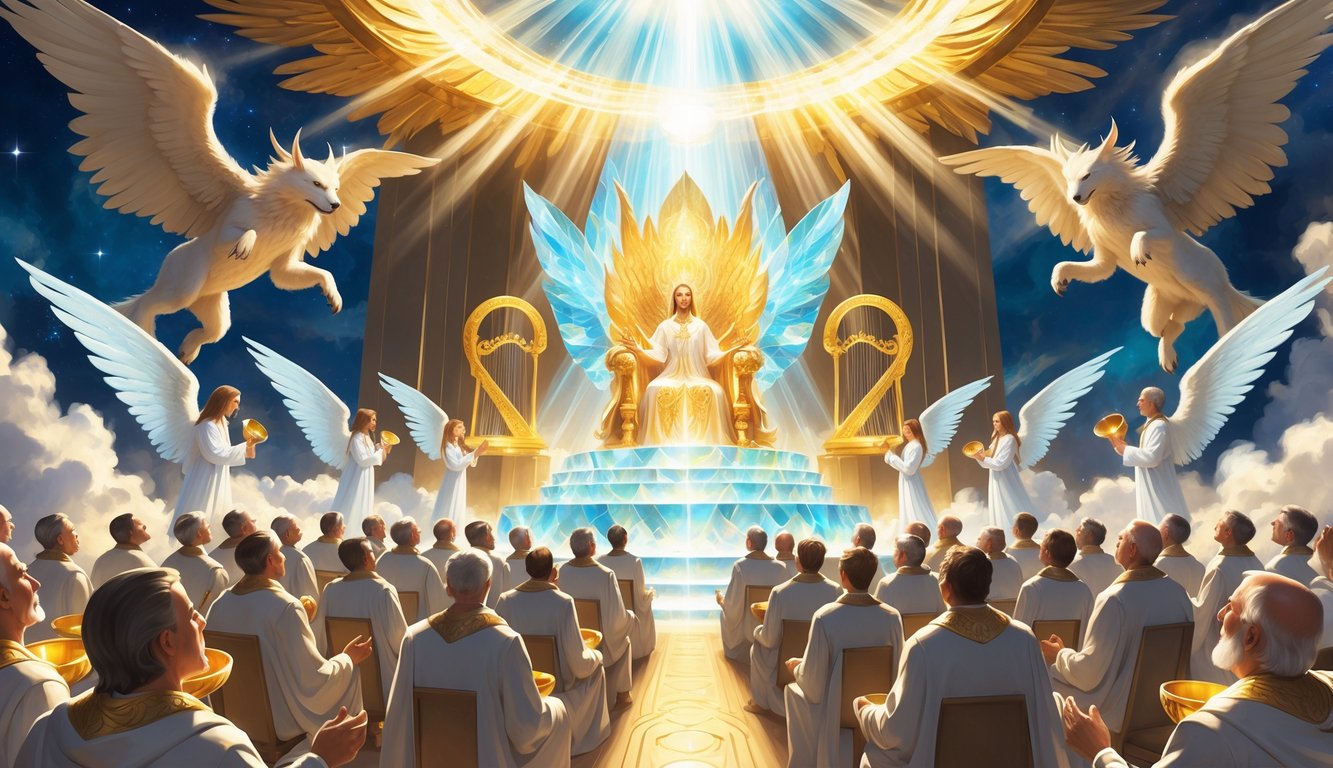
In John’s vision, worship in heaven centers on God’s throne. Heavenly beings give constant praise, showing God’s holiness and power.
The scene is structured, with specific acts and words that express reverence and gratitude.
Songs of Praise
John describes four living creatures who never stop declaring, “Holy, holy, holy is the Lord God, the Almighty, who was and who is and who is to come.” This ongoing praise emphasizes God’s eternal nature.
Their words focus on God’s holiness, His authority over all creation, and His unchanging existence. This makes the worship both personal and rich in meaning.
The twenty-four elders respond by affirming God’s worthiness to receive glory, honor, and power. These songs declare truth about God’s character.
The pattern of praise—creatures speaking, elders responding—shows an ordered form of worship. It reflects unity among those in heaven, as all voices agree on God’s worthiness.
For readers, this reveals that worship is both verbal and intentional. It is grounded in specific truths about who God is.
Casting Crowns Before the Throne
The twenty-four elders wear crowns, which represent authority and reward. In the vision, they take these crowns and place them before God’s throne.

This act is symbolic, showing that all authority comes from God. By casting their crowns, they acknowledge that God alone deserves ultimate honor.
It is a visible way of saying, “Worthy are You, our Lord and God, to receive glory and honor and power.” Worship here is not only spoken but also demonstrated through symbolic acts.
The gesture also reflects humility. Even those with high status in heaven submit fully to God’s rule.
For more on this throne room scene, Revelation 4:1-11 provides detailed imagery of this moment.
Glory and Honor to God
The worship in heaven gives glory, honor, and thanks directly to God as Creator. The elders proclaim that all things exist because of His will.
This places creation itself within the context of God’s purpose. The focus is on God’s worthiness, not human achievement.
Every phrase in the worship scene points back to His role as the source of life and order. This worship is continuous, not occasional.
It reflects heaven’s recognition of God’s unchanging nature and His right to rule. The words used are simple but full of meaning.
They express gratitude for creation and recognition of sovereignty. The worship scene in Revelation 4 also acknowledges God’s eternal power.
The Scroll and the Seven Seals
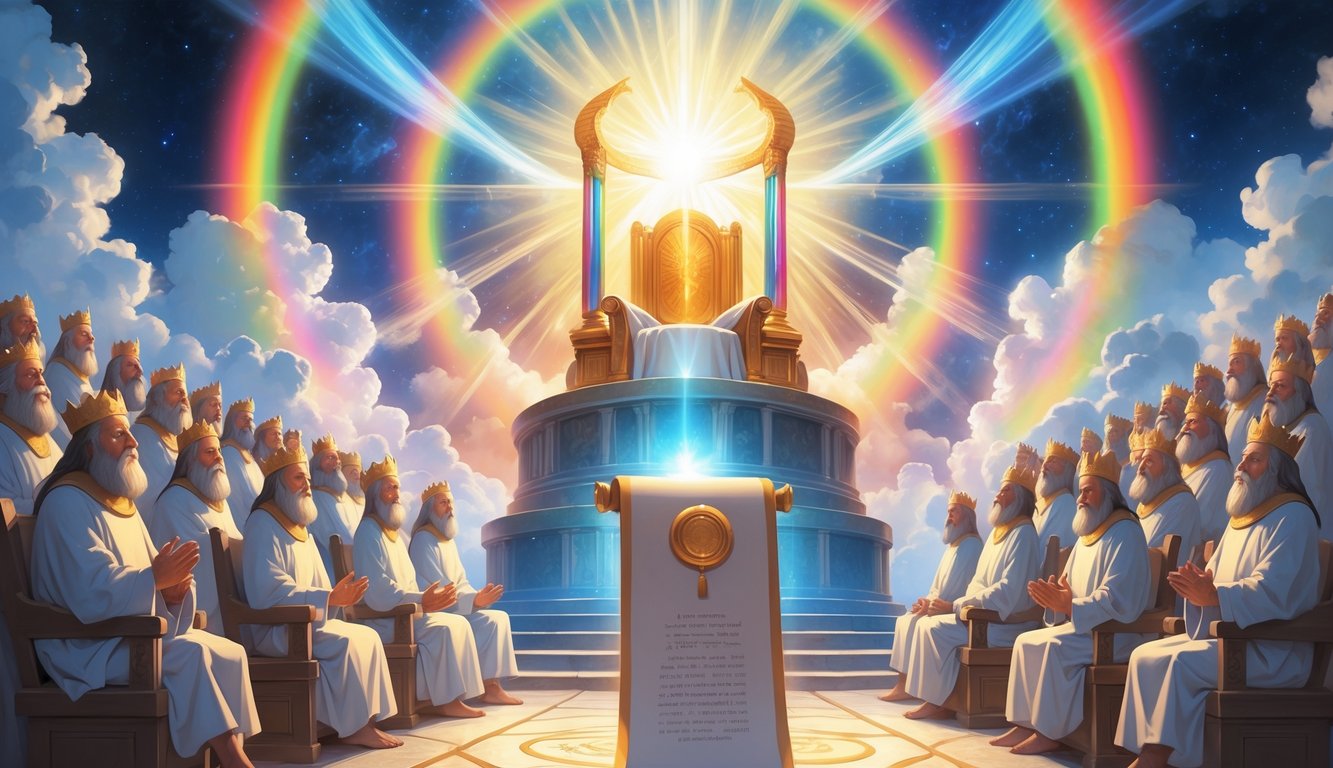
In John’s vision, a scroll appears in the right hand of the one seated on the throne. It is sealed with seven seals, and its contents remain hidden until the seals are opened.
A search begins for someone worthy to open it. The moment becomes tense before the Lamb steps forward.
The Mysterious Scroll
John sees a scroll written on both sides and sealed with seven seals. This detail shows it is complete and nothing can be added or removed.
The seals keep its message secure until the right person opens it. The scroll rests in the right hand of God, symbolizing His authority over its contents.
Its writing on both sides suggests a full and final record, possibly of God’s plan for the kingdom and the future. In the vision described in Revelation 5:1, the scroll is not just a document—it is a declaration that only the worthy can reveal.
Until the seals are broken, no one can read or act on what it contains.
The Search for Worthiness
A mighty angel calls out with a loud voice, asking, “Who is worthy to open the scroll and break its seals?” No one in heaven, on earth, or under the earth can open it or even look inside.
This universal search shows that worthiness is about moral and spiritual authority, not strength or position. John reacts with deep sorrow—he weeps because it seems the scroll will remain sealed forever.
Then the scene changes. One of the elders tells John to stop weeping.
The Lamb, who appears as though slain, has triumphed and is worthy to open the scroll. This moment shifts the focus from the problem to the solution.
The Seven Seals
The seven seals are not opened all at once. Each seal releases a new event or revelation, moving God’s plan forward step by step.
The number seven often represents completeness in Scripture. The seals together form a complete sequence.
Breaking the seals is an act of authority and judgment. As each is opened later in Revelation, it brings events that affect both heaven and earth.
These moments show the seriousness of the scroll’s contents. The seals connect the throne room vision to the unfolding events of the kingdom’s future.
They mark the transition from worship in heaven to actions that will shape history.
The Lamb: Jesus Christ in the Throne Room
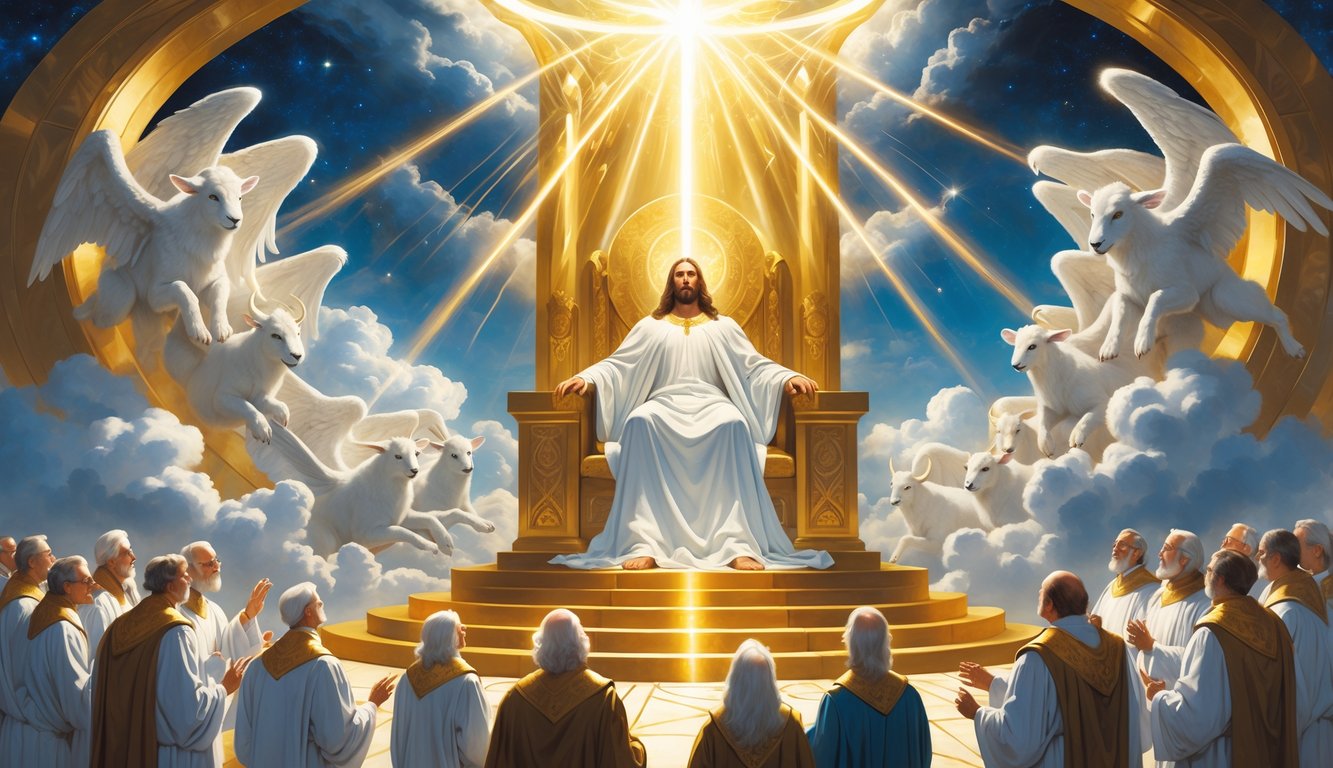
John’s vision in Revelation 4-5 presents Jesus Christ as both powerful and sacrificial. He is described with titles that connect Him to Old Testament prophecy and to God’s plan for redemption.
These titles show His authority, His role in salvation, and His fulfillment of God’s promises.
The Lion of the Tribe of Judah
In Revelation 5:5, one of the elders tells John that the Lion of the tribe of Judah has triumphed. This title links Jesus to Jacob’s blessing over Judah in Genesis 49:9-10, where a lion symbolized strength and kingship.
The lion image points to authority and victory. It shows that Jesus has the right to rule and to open the scroll in God’s hand.
The scroll represents God’s plan for history. This title also connects to the prophecy that the ruler would come from Judah’s line.
It assures believers that God’s promises in the Old Testament are fulfilled in Christ.
The Lamb Who Was Slain
When John looks, he sees not a lion, but a lamb that appears to have been killed yet is alive. This image shows Jesus’ sacrificial death for humanity’s sins.
The lamb stands at the center of the throne, sharing in God’s authority and honor. The scene shows all of heaven worshipping the Lamb.
They declare Him worthy to open the scroll because of His sacrifice. As described in Revelation 4-5, worship shifts from God the Father to Christ the Lamb, affirming His divinity.
The lamb’s wounds are a lasting reminder of the cost of redemption. His resurrection proves His victory over death.
He alone can carry out God’s final plan.
The Root of David
Jesus is also called the Root of David in Revelation 5:5. This title refers to Isaiah 11:1 and 11:10, where a shoot and root from David’s family line would bring justice and peace.
The “root” means He is both the source and descendant of David. As the source, He existed before David.
As the descendant, He fulfills God’s covenant promises to David’s house. This title emphasizes His eternal nature and His rightful place as the promised king.
It confirms that the Lamb is not only Savior but also the ruler who will reign forever, as seen in biblical prophecy.
Redemption and the Kingdom of Priests
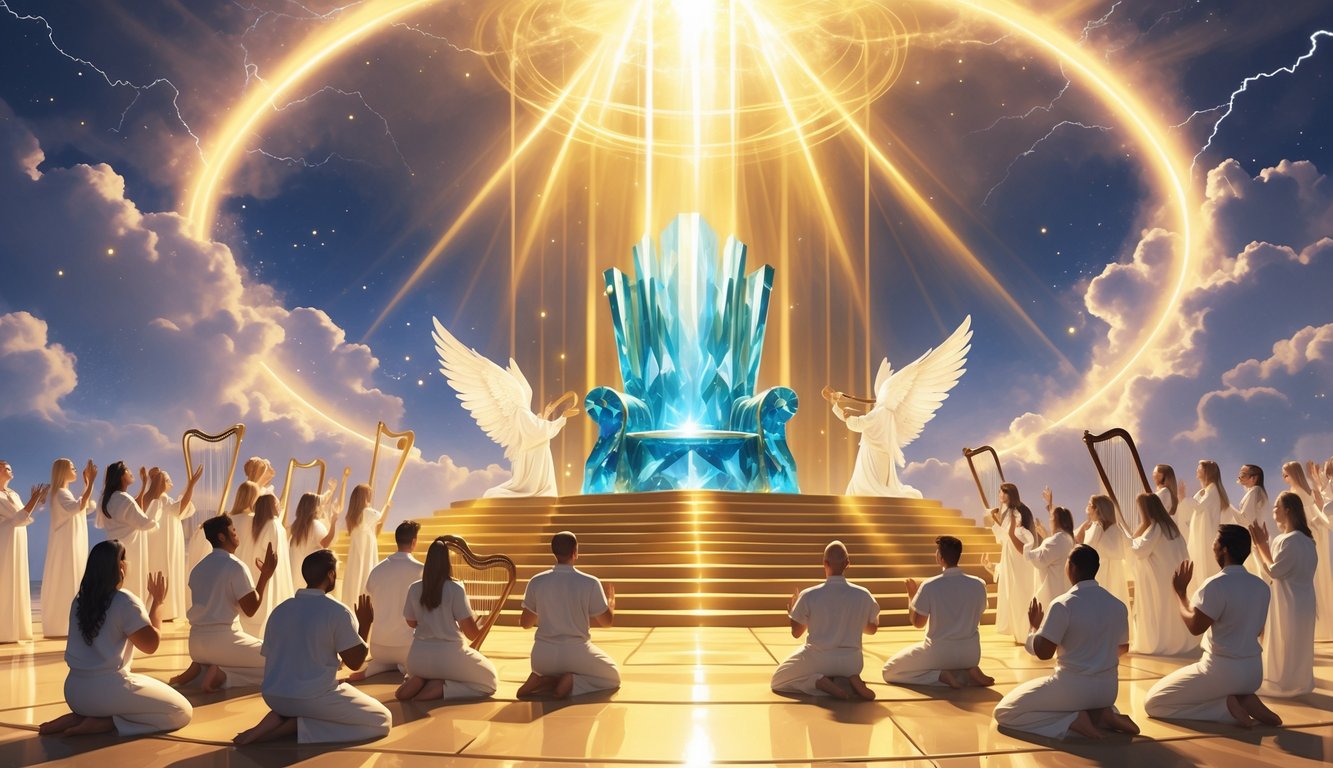
John’s vision shows that Jesus’ work not only rescues people from sin but also gives them a new role and purpose.
Those redeemed are brought into God’s kingdom and called to serve Him in a priestly way, sharing in His rule through Christ.
The Song of Redemption
In Revelation 5, the elders and living creatures sing a new song. They praise the Lamb for purchasing people for God with His blood.
The song is specific. It says the redeemed come from every tribe, language, people, and nation.
This shows that salvation is not limited to one group but is open to all. The focus is on what Jesus has done, not on human effort.
The act of redemption is complete and final. It is the basis for worship in heaven.
This new song is not just music—it is a declaration of truth. It reminds the church that worship centers on Christ’s sacrifice and the unity it creates among believers.
A Kingdom and Priests to God
The vision says that the redeemed are made into a kingdom and priests. This language echoes Old Testament promises given to Israel in Exodus 19:6.
As priests, they have direct access to God. They can offer spiritual sacrifices such as prayer, thanksgiving, and service.
As a kingdom, they live under God’s rule and authority. This kingdom is not political but spiritual, shaping how believers live and interact with others.
The church today continues this calling. Every believer has a role in representing God to the world and bringing the world’s needs before God in prayer.
Reigning With Christ
Revelation 5 also says that the redeemed will reign on the earth. This reign is tied to Christ’s authority, not human power.
The New Testament often links this reign to the future when Christ returns. Yet, believers also share in His victory now by living under His leadership.
Reigning with Christ means serving with Him. It is leadership marked by humility, justice, and faithfulness.
This promise gives hope to the church, especially in times of hardship. It assures them that their present struggles will lead to a future where they share in Christ’s rule forever.
Theological and Old Testament Connections
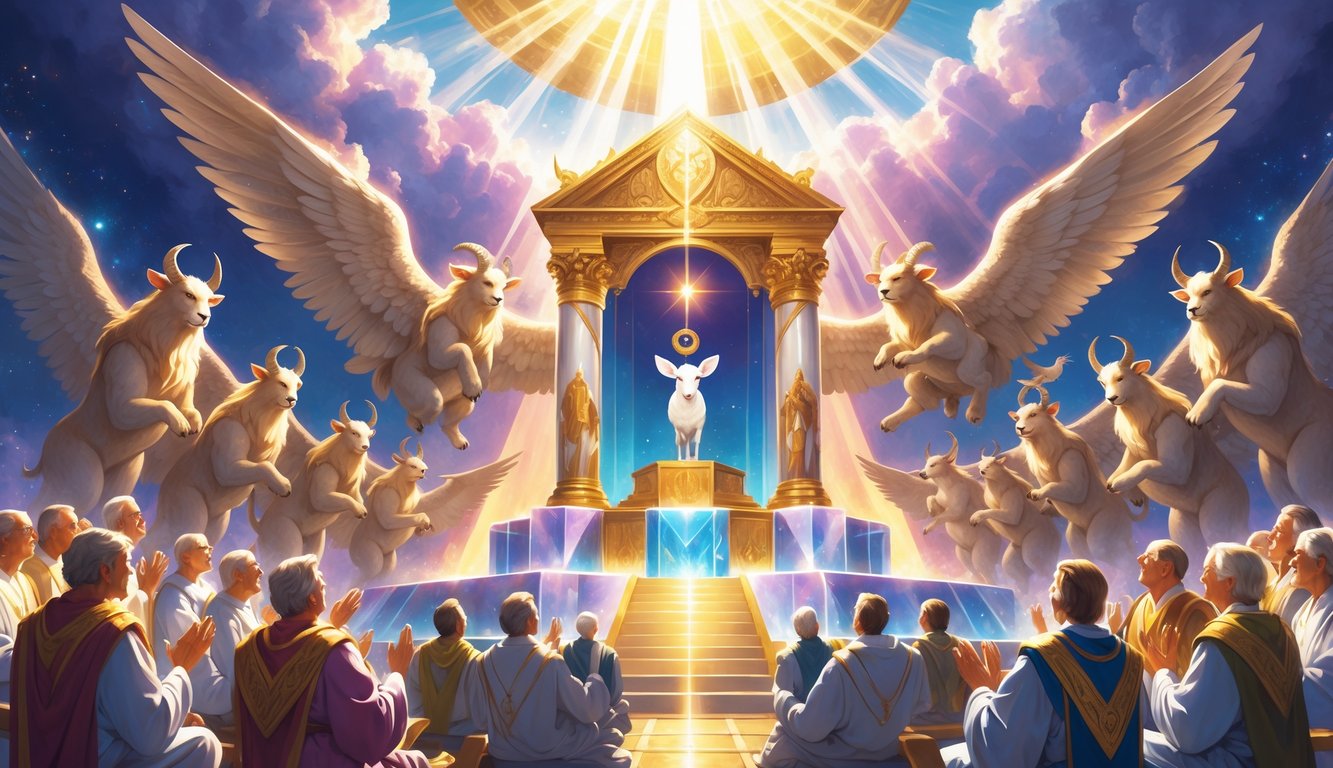
Revelation 4–5 draws on earlier biblical visions to describe God’s throne and the worship that surrounds it. These chapters connect the heavenly scene to Old Testament imagery, prophecy, and the expectation of God’s ultimate rule.
The vision blends symbols from Israel’s scriptures with the fulfillment seen in Christ’s reign.
Old Testament Imagery in Revelation 4-5
John’s vision in Revelation 4 echoes throne room scenes from Isaiah 6 and Ezekiel 1. In both, God is seated on a high throne, surrounded by heavenly beings.
The four living creatures in Revelation resemble the cherubim described in Ezekiel, each with distinct faces and covered with eyes. The rainbow around the throne recalls God’s covenant with Noah in Genesis 9.
The twenty-four elders may reflect the priestly divisions in 1 Chronicles 24, symbolizing a complete representation of God’s people. The constant praise of “Holy, holy, holy” mirrors Isaiah’s vision.
The sea of glass before the throne may reflect the “expanse” in Ezekiel’s vision. These parallels show that John’s imagery is rooted in Old Testament throne room scenes, linking his vision to God’s revealed glory throughout history.
Fulfillment of Prophecy
Revelation 5 introduces the Lamb who is worthy to open the sealed scroll. This fulfills messianic promises from passages like Isaiah 11, where the root of Jesse brings justice and peace.
The Lamb’s appearance as “slain” reflects Isaiah 53’s suffering servant. The worship of the Lamb by every creature fulfills Psalm 72’s vision of worldwide homage to God’s chosen king.
The scroll itself may connect to Daniel 12, where sealed words await the time of the end. By combining these elements, John presents Jesus as the one who completes God’s plan foretold in the prophets.
The vision blends ancient expectations with the reality of Christ’s reign, as seen in the heavenly worship scene of Revelation 4–5.
The Purpose and Impact of the Throne Room Vision
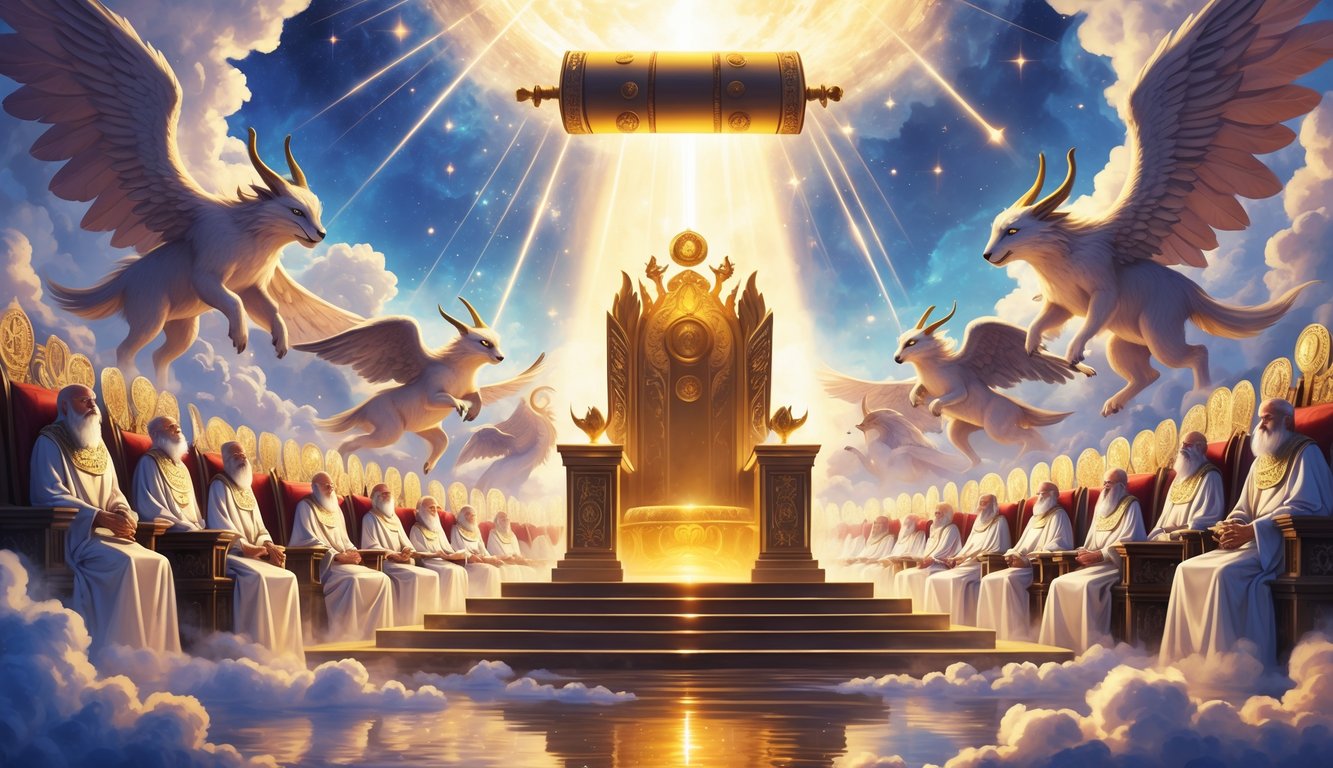
John’s vision in Revelation 4–5 shows God’s glory and His authority over creation. It also highlights the central role of worship in heaven.
The vision reminds believers that God’s rule never fails. His plans continue with purpose.
Encouragement for the Church
The early church faced pressure and persecution. This vision reassured them that God still reigned despite earthly troubles.
John saw the throne at the center of heaven. Elders and living creatures surrounded it, offering constant praise.
This image confirmed God’s control, not human rulers. For struggling believers, the vision brought hope.
It reminded them that their faith connected them to a greater reality beyond hardship. The church found courage knowing that worship in heaven was unending.
Their worship on earth joined with the worship in heaven. This gave them strength to remain faithful in daily life.
The Call to Worship
The vision did not only comfort—it called for action. The scene showed all beings in heaven giving honor to God as Creator and Redeemer.
In Revelation 4:11, the elders declare God worthy because He created all things. In Revelation 5, the Lamb—Jesus—is praised for His sacrifice.
This dual focus on creation and redemption shapes Christian worship. Worship is not casual or optional.
It is a response to who God is and what He has done. The throne room shows that worship means giving God the glory He deserves.
The church should center worship on God’s greatness and His saving work, not on human achievement.
Relevance for Believers Today
The throne room vision still speaks to modern believers. It reminds them that God’s glory is the true center of life, not cultural trends or personal ambitions.
In times of uncertainty, this vision directs attention upward. It calls people to trust God’s rule even when the world feels unstable.
Believers today can see their worship as part of a continuous chorus that stretches from earth to heaven. This perspective gives meaning to gathering with the church, praying, and singing praises.
